How do I know when my tree needs trimming? It’s a question homeowners across Gilbert, AZ ask us regularly, standing in the yard, staring at a tree that looks a little off, wondering whether it actually needs attention or whether they’re overthinking it. Figuring out the right time to trim isn’t always obvious, and making the wrong call in either direction carries real consequences. Wait too long, and a dead limb comes down in a windstorm. Prune too early or too aggressively, and you can cause damage that takes years to show up. This article walks you through the visual signs, the structural red flags, the seasonal timing, and the moments when second-guessing yourself is a signal to call a certified arborist instead.
The good news is that most trees are surprisingly communicative. Once you know what to look for, a quick visual inspection can reveal many common issues, whether a tree is thriving, overdue for maintenance, or showing signs of something more serious. Here’s how to read those signs, starting with what’s visible from the ground and moving toward what takes a trained eye to catch.
How do I know when my tree needs trimming? Start with these visual signs
Most pruning decisions start with what you can see from the ground. You don’t need a ladder, a degree in horticulture, or any special equipment to spot the clearest indicators that a tree is ready for work. These are the signals a healthy, well-maintained tree simply doesn’t show.
Dead, broken, or hanging branches
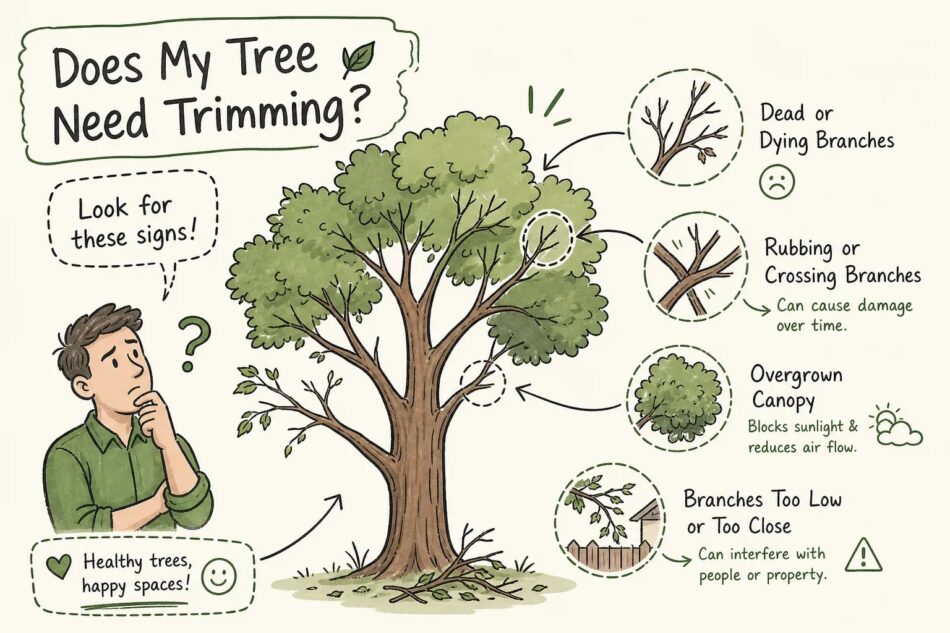
Dead branches are one of the clearest signs a tree needs trimming. They look brittle, gray or brown, and show no buds during the growing season. When you apply gentle pressure, they snap cleanly instead of bending. The concern isn’t just aesthetics, dead wood falls without warning, and a moderate wind or rain event is often all it takes. If a branch shows significant dieback while the rest of the tree looks healthy, that’s a strong pruning signal. That said, widespread or progressive dieback could point to a systemic disease, so it’s worth consulting a certified arborist before removing limbs if you’re unsure of the cause.
An overgrown canopy causing shade and crowding problems
A crowded canopy has a recognizable look and feel. Light stops reaching the lawn or garden below, interior limbs appear bare because lower growth can’t compete, and the tree’s silhouette looks dense and shapeless rather than structured. Dense, unmanaged canopies trap moisture and restrict airflow, which creates near-ideal conditions for fungal disease to take hold. If you’re losing grass or ground cover directly beneath the tree and the interior branches are thinning out, the canopy has outgrown its own structure.
Water sprouts and suckers draining the tree’s energy
Water sprouts are fast-growing vertical shoots that emerge from major limbs or the trunk, often in response to stress or a previous pruning wound. Suckers grow from the roots or at the base of the trunk, sometimes below the graft union on ornamental trees. Both draw energy away from healthy, productive growth. They’re not a cosmetic nuisance, they are a pruning target, and prompt removal is generally the right call as soon as they appear.
Structural red flags that go deeper than the canopy
Once you’ve looked at the obvious surface signs, it’s worth examining the tree’s underlying architecture. Some of the most serious problems aren’t about how the tree looks overall, they’re about specific structural points that represent long-term failure risks, especially when storm loads or high winds come into play.
Crossing and rubbing limbs
Two limbs that cross and rub against each other are doing constant damage to both. Every point of contact removes bark, the tree’s natural protective layer, and those wounds become entry points for pests and pathogens. Over time, one limb typically dominates and the other weakens and dies. Catching crossing limbs early, before the damage becomes significant, is one of the most straightforward structural pruning tasks a professional handles during a routine visit.
Weak branch unions and co-dominant stems
Narrow V-shaped crotches are among the most common structural failure points a certified arborist looks for during an inspection. So are co-dominant stems, two trunks of roughly equal size competing at the top of the tree. These junctions hold significant tension under load, and during Arizona’s monsoon storms, that load can be severe and sudden. A U-shaped union with a visible branch collar is structurally sound; a tight V-shape with bark pressed inward is a warning sign that deserves professional evaluation before the next storm season.
Branches growing toward structures or utility lines
A branch doesn’t have to touch a roof, fence, or power line to be a problem. Branches growing toward those targets create pressure points, and during storms, even moderate wind loads can send them exactly where you don’t want them. Any branch in proximity to electrical lines is a professional-only concern. This isn’t a situation that yields to a homeowner with a handsaw, and it should be treated accordingly from the start.
Seasonal cues: reading your tree’s pruning calendar
Knowing what to look for is only part of the equation. When you act on those signs matters just as much. The timing of a pruning cut affects how quickly the tree heals, how vulnerable it is to pests and disease, and whether you’re working with the tree’s biology or against it.
Why late winter is the sweet spot for most deciduous trees
Most deciduous trees pruned during dormancy, from late winter to early spring before bud break, heal faster and face less exposure to the insects and pathogens that target fresh cuts during warm months. There’s a practical bonus, too: without leaves in the way, the tree’s structure is fully visible, which makes cut decisions cleaner and more accurate. For the majority of common U.S. shade trees, late winter dormancy pruning is the default recommendation from arborists and university extension programs alike.
Spring-flowering trees: prune after the show, not before it
Species like magnolia, lilac, and forsythia bloom on the previous year’s wood. If you prune them in late winter, you remove the buds before they get a chance to open. The rule is straightforward: wait until the flowers drop, then prune within two to six weeks of bloom. This preserves next season’s display without letting the tree go unmanaged.
Timing in a desert climate: what changes in Arizona
Arizona’s heat cycles shift the trimming calendar in ways that generic national advice doesn’t account for. In the low desert, the primary pruning window for most shade trees runs from January through March, according to Arizona Cooperative Extension guidance. Native desert species like mesquite and palo verde often do well with early summer pruning in May to early June, before peak heat arrives. In our experience working with desert trees daily, avoiding heavy pruning during the hottest summer months holds true across species. This is one area where a local, ISA-certified arborist offers a meaningful edge over general gardening resources.
Disease, pests, and normal leaf drop: knowing what you’re actually looking at
One of the most common reasons homeowners consider pruning is because the tree looks thin, leaves are dropping, or branches appear sparse. The problem is that these symptoms can mean very different things, and the right response depends entirely on which one you’re dealing with.
Leaf and branch symptoms that point to disease
Disease typically shows up as leaf spots with defined margins, cankers on the bark surface, or progressive dieback that moves from branch tips inward regardless of irrigation or rainfall. Wilting that doesn’t correspond to recent drought conditions is another signal worth investigating. Diseased wood can sometimes be pruned to slow the spread, but only if the infection is clearly localized and hasn’t moved into the main scaffold or trunk tissue. Pruning infected wood without addressing the underlying disease rarely solves the problem on its own.
How pest damage looks different from disease or stress
Pest infestation leaves a different kind of evidence: chewed or notched leaf edges, visible exit holes in the bark, sticky honeydew residue on leaves or surfaces beneath the tree, webbing, or actual insects visible on the tissue. These patterns are distinct from the progressive, spreading discoloration that disease produces. Removing heavily infested branches can help, but treating the underlying pest problem needs to happen alongside pruning, not as a substitute for it.
When it’s just the tree doing what trees do
Gradual shedding of older or interior leaves, particularly in evergreens, is often completely normal. If the overall canopy looks full, new growth is active and healthy, and there are no other symptoms, the tree probably doesn’t need trimming right now. Pruning in response to normal seasonal leaf drop can actually stress the tree unnecessarily and create wounds that didn’t need to exist. When in doubt, give the tree a few weeks and see whether the pattern resolves or progresses.
Emergency tree trimming: when to call now
Some of what you find in your yard isn’t a “schedule a trim soon” situation, it’s a call-someone-today situation. Recognizing the difference matters, because waiting weeks on a routine quote when a branch is structurally compromised puts your property and anyone in the yard at real risk.
Storm-damaged, cracked, or hanging limbs
Limbs that cracked during a storm but didn’t fully separate are among the most dangerous hazards on a residential property. They can fail under the smallest additional load and give almost no warning before they do. If a limb is visibly split, hanging at an unusual angle, showing visible movement at the union, or you can hear audible cracking sounds during wind, treat it as an emergency trimming situation, not something to monitor. The phrase “widowmaker” exists for a reason, and it applies directly to partially attached limbs in residential trees.
Trees or major limbs near power lines
Any tree in contact with or actively growing toward a utility line needs professional attention, and it needs it promptly. This is not a DIY scenario under any circumstances. The risk extends well beyond the tree and the property: contact with electrical infrastructure is a fire and electrocution hazard, and only a contractor who is both certified and properly equipped should get anywhere near that work.
Sudden lean, uplifted roots, or soil cracking at the base
A tree that has visibly shifted its lean after a rain or wind event is showing signs of root failure. Uplifted soil around the base, cracking ground, or roots that were previously buried and are now exposed all point to a compromised structural anchor. This is not a trimming problem, it is a removal and safety assessment situation. Get a professional on-site the same day if you see these signs, especially if the tree is near any occupied structure.
DIY pruning versus calling a certified arborist
Not every pruning task requires professional help. Some of it genuinely falls within what a careful homeowner can handle. But the line between manageable DIY work and work that causes lasting damage is closer than most people expect.
What most homeowners can safely handle on their own
Light pruning of small branches at heights under ten feet, removing obvious deadwood from young trees, and cleaning up suckers at the base of the trunk are all reasonable homeowner tasks. The keys are using sharp, clean tools and making cuts just outside the branch collar at the correct angle. A sharp cut through a small branch at the right location heals quickly and cleanly. A ragged cut at the wrong point does not.
Where DIY trimming causes long-term damage
The most damaging DIY mistakes share a common thread: they feel reasonable in the moment but create structural or health problems that compound over years. Flush cuts that remove the branch collar prevent proper wound closure and invite internal decay. Long stubs die back and rot inward. Topping a tree, cutting main branches back to stubs, triggers weak, fast-growing regrowth with poor attachment angles and significantly increases the risk of future failure. Removing large portions of the canopy at once stresses the tree and makes it more vulnerable to disease, pests, and storm damage; follow species-specific guidelines rather than guessing at a safe limit. These are not cosmetic mistakes, they change how the tree grows and holds up for the rest of its life.
When a certified arborist changes the outcome
A certified arborist brings structural diagnosis, proper cut placement, species-specific knowledge, and the right equipment for anything beyond basic low-level work. For Gilbert homeowners, that also means someone who understands desert-native species, Arizona’s unique growth patterns, and how the monsoon season changes risk profiles for certain trees. The team at Gilbert Tree Trimmers includes ISA-certified arborists ready to assess your property and give you a straight answer on what your trees actually need, and what they don’t, before anyone picks up a saw.
A quick tree maintenance checklist: prune, or remove?
If you’re still asking yourself how do I know when my tree needs trimming versus something more serious, this checklist can help you frame the decision before you call a professional.
- Prune when you see isolated dead or hanging branches, crossing limbs, water sprouts, suckers, or a canopy that has outgrown its structure.
- Prune with caution when dieback is present, rule out systemic disease before removing limbs, and consult an arborist if the pattern is spreading.
- Consider removal when the tree has significant root failure, a severe lean that developed suddenly, extensive trunk decay, or when more than half the canopy is dead or diseased.
- Call for emergency service when you see cracked or partially detached limbs, contact with power lines, or sudden structural failure after a storm.
- Do nothing yet when the only symptom is gradual interior leaf shed on an otherwise healthy evergreen, give it a few weeks and reassess.
Taking the right next step
You’ve got the checklist now, dead wood, structural red flags, seasonal timing, and the difference between disease and normal turnover. Recognize emergencies when they show up, and be honest with yourself about where your DIY comfort zone ends.
Still asking yourself how do I know when my tree needs trimming, and not quite sure after reading through the signs? That’s exactly when a professional set of eyes makes sense. The certified arborists at Gilbert Tree Trimmers are available for on-site consultations with no obligation, you’ll walk away knowing exactly what your tree needs and what it doesn’t, with honest advice from people who work with Gilbert trees every day. Reach out to our team and get a clear answer before a small question becomes a big problem.